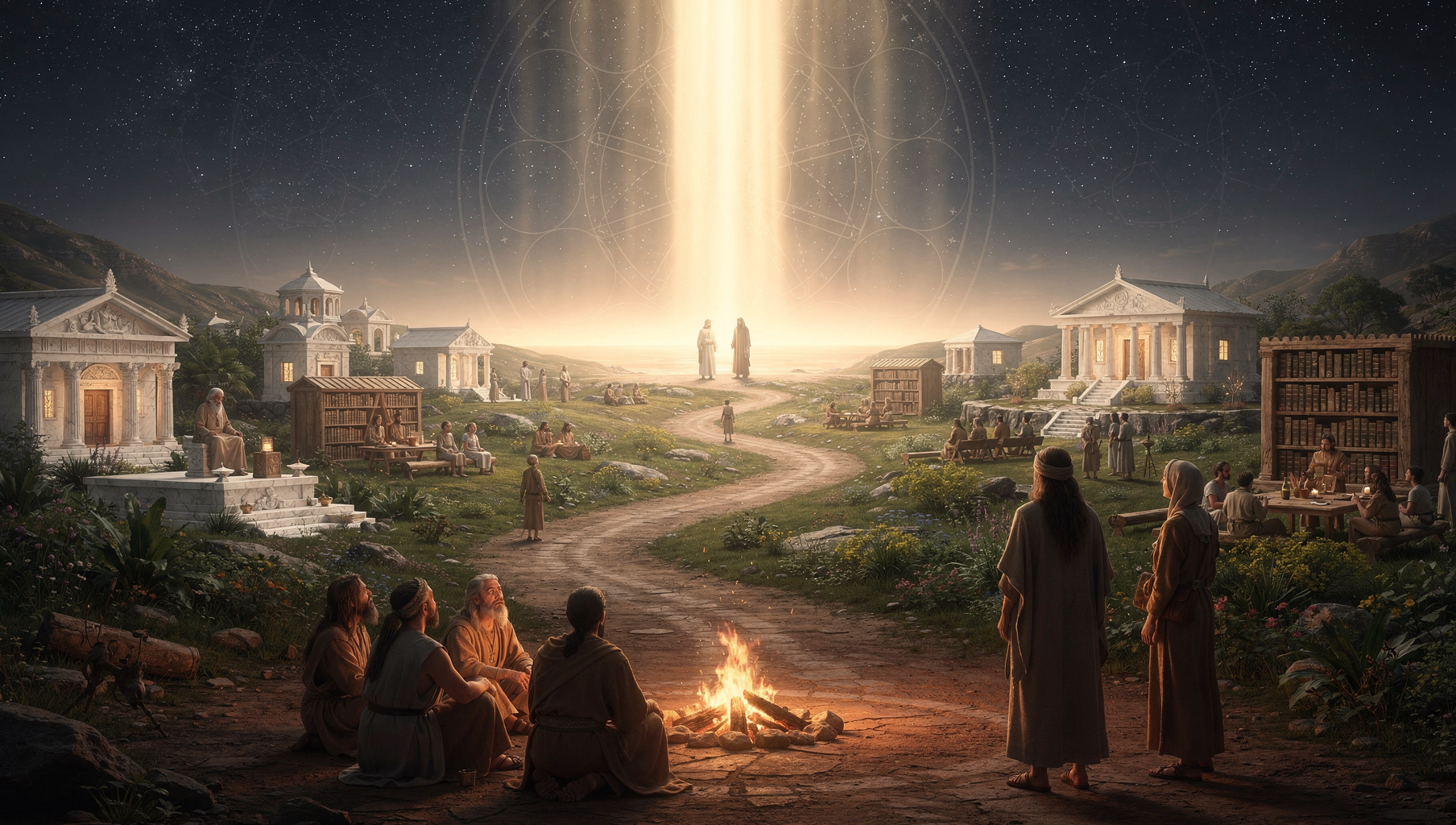
“It is a part of the plan of the universe that, sooner or later, evolutionary religion is destined to receive the spiritual expansion of revelation.” 101:5.4 (1110.7)
Humanity's search for God has been unfolding for thousands of years. Long before organized theology, human beings looked toward the heavens, wondered about the forces shaping existence, and searched for meaning beyond themselves. From those early attempts emerged traditions, rituals, symbols, moral teachings, and ideas about the divine. These expressions of religion were imperfect because humanity itself was still growing. Yet they represented something profoundly important: the human desire to reach beyond the visible world and discover the reality behind it. The search itself was part of the journey.
Revelation introduces another dimension to that journey. If evolutionary religion represents humanity's gradual groping toward truth, revelation represents truth being brought more directly into human understanding. But the two do not necessarily have to be enemies. Revelation can expand what humanity has already discovered rather than simply destroying it. A person who learns something new does not necessarily need to reject everything they knew before. Their previous understanding can become the foundation upon which a larger understanding is built. In the same way, spiritual revelation can enlarge religious consciousness, introducing greater meanings, higher values, and a more complete vision of God.
This principle also applies personally. Each of us develops spiritually through stages. There are ideas about God that once made sense to us but eventually become too small for what we are experiencing. There are beliefs we inherit, assumptions we accept, and answers we consider complete—until life presents us with a deeper question. Spiritual maturity requires the humility to allow our understanding to expand. We do not have to be ashamed of what we once believed. We can honor the stage we were in while remaining open to what comes next. Growth requires both gratitude for the past and courage to move beyond it.
Perhaps this is one of the great purposes of revelation: to prevent humanity's understanding of God from becoming permanently confined to yesterday's discoveries. Truth is not exhausted by one generation, one culture, or one religious expression. The spiritual journey remains alive because the universe itself is alive with meaning and purpose. As humanity grows in capacity, its understanding can also grow. What once seemed mysterious can become clearer. What once seemed separate can become connected. What once appeared to be the end of the journey can reveal itself as another beginning.
The invitation, then, is not to abandon the spiritual journey of humanity but to continue it with an expanded vision. Evolutionary religion asks, “What can we discover?” Revelation answers, “There is more to discover.” And perhaps the most spiritually mature response is simply to remain open enough to receive it.
What belief about God or spirituality have you outgrown—not because it was completely wrong, but because your understanding has become larger?